There are places in the world where the ground beneath you carries a weight that has nothing to do with tourism or reputation. The Sacred Valley of the Incas is one of them. The terraced hillsides, the Urubamba River running through the valley floor, the Apus — the sacred mountains that frame the landscape on both sides — all of it has been understood as ceremonially significant for longer than most cultures have records. Long before ayahuasca ceremonies began drawing international visitors to this region, the valley was already a site of active and continuous spiritual practice.
That history is not incidental to an ayahuasca retreat Sacred Valley Peru. It is part of what the setting provides.
This guide covers what makes the Sacred Valley specifically distinct as a ceremonial setting — the geography, the cosmology, the Inca heritage sites, the dual healing tradition available here and nowhere else, and the practical differences between a retreat in the valley versus Cusco city or the Amazon.
Table of Contents
The Sacred Valley: Geography and Scale
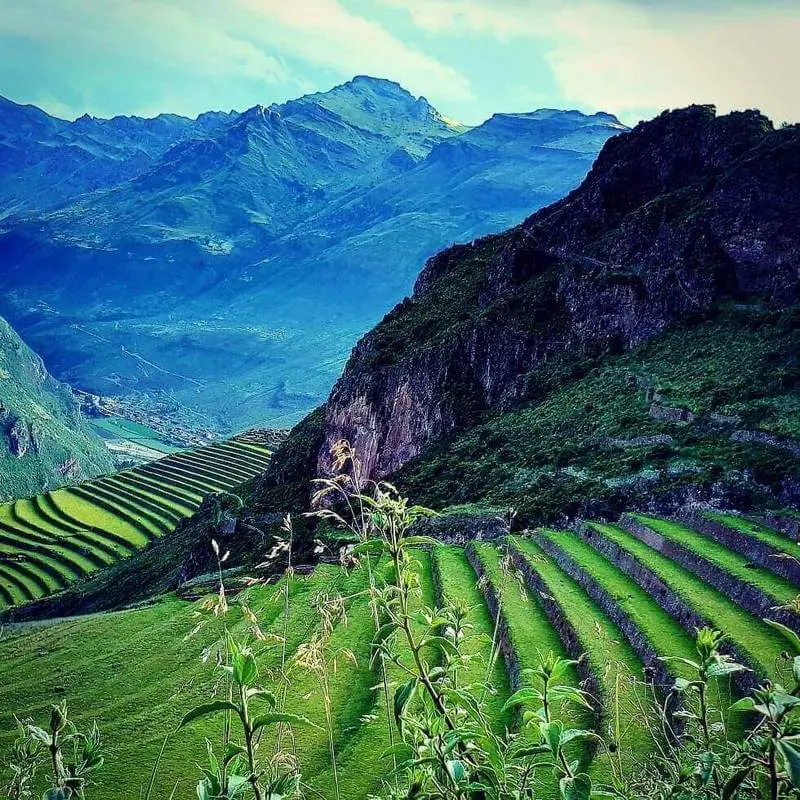
The Sacred Valley of the Incas — Willka Mayu in Quechua, the Sacred or Holy River — stretches approximately 60 kilometers through the Andes northwest of Cusco, following the Urubamba River from the town of Pisac to Ollantaytambo. It sits at between 2,700 and 3,000 meters above sea level — notably lower than Cusco city at 3,400 meters — in a narrow corridor flanked by mountain ranges that rise another thousand meters on both sides.
The valley was not merely a geographic feature to the Inca civilization that flourished here between the 13th and 16th centuries. It was understood as a living axis of the world — a place where the terrestrial and the celestial met, where agricultural abundance and spiritual power were inseparable. The word willka carries connotations of both sacred and solar — a word used for the sun, for sacred animals, and for the valley itself. This was the heartland of the civilization, not its periphery.
That context is present in a ceremony held in this valley in a way that cannot be replicated by setting. The agricultural terraces carved into the hillsides by Inca engineers, the ancient stones of Pisac visible from the valley floor, the Urubamba running continuously below — these are not backdrop. They are the environment, and environment shapes ceremony.
Ayahuasca Retreat in Cusco
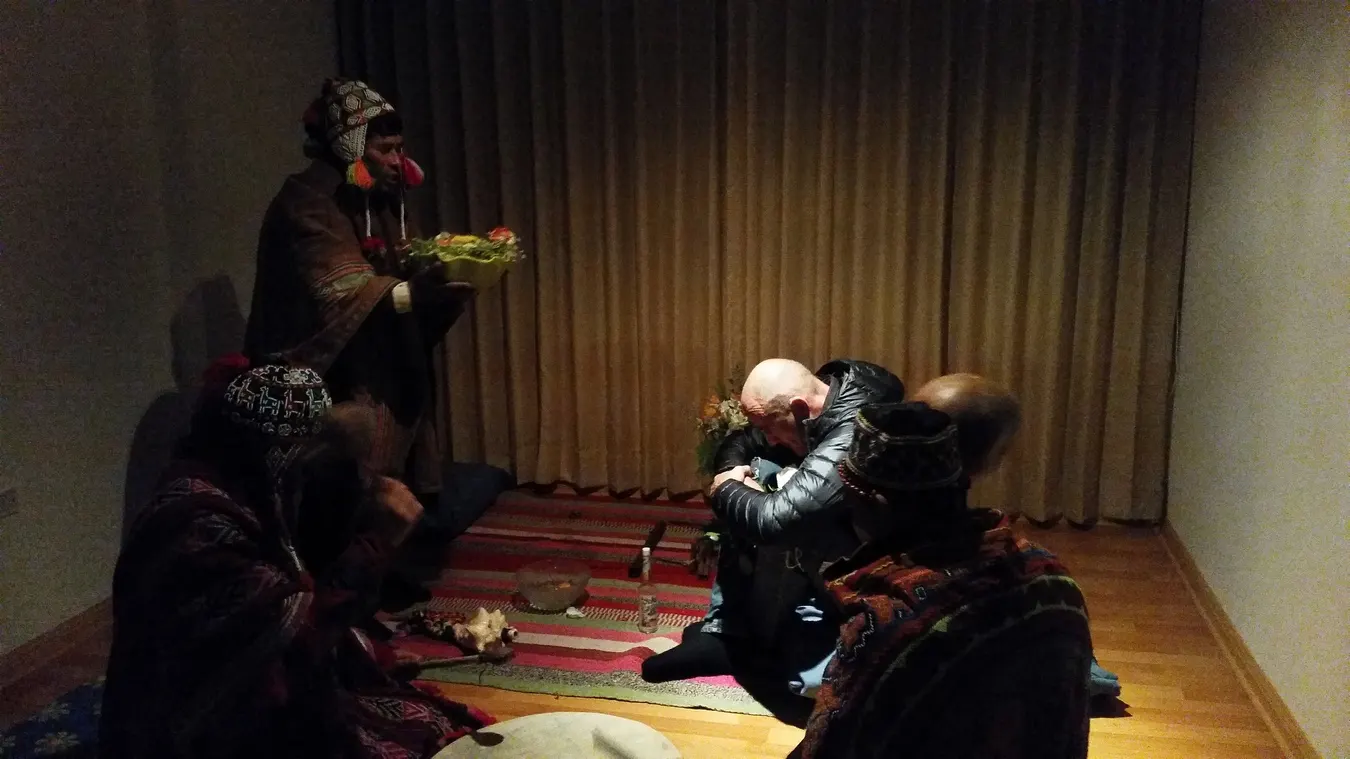
1 Day Ayahuasca Retreat Cusco
Designed for visitors with little time seeking a profound spiritual experience, the 1 Day Ayahuasca Retreat in Cusco, Peru is meant for them.
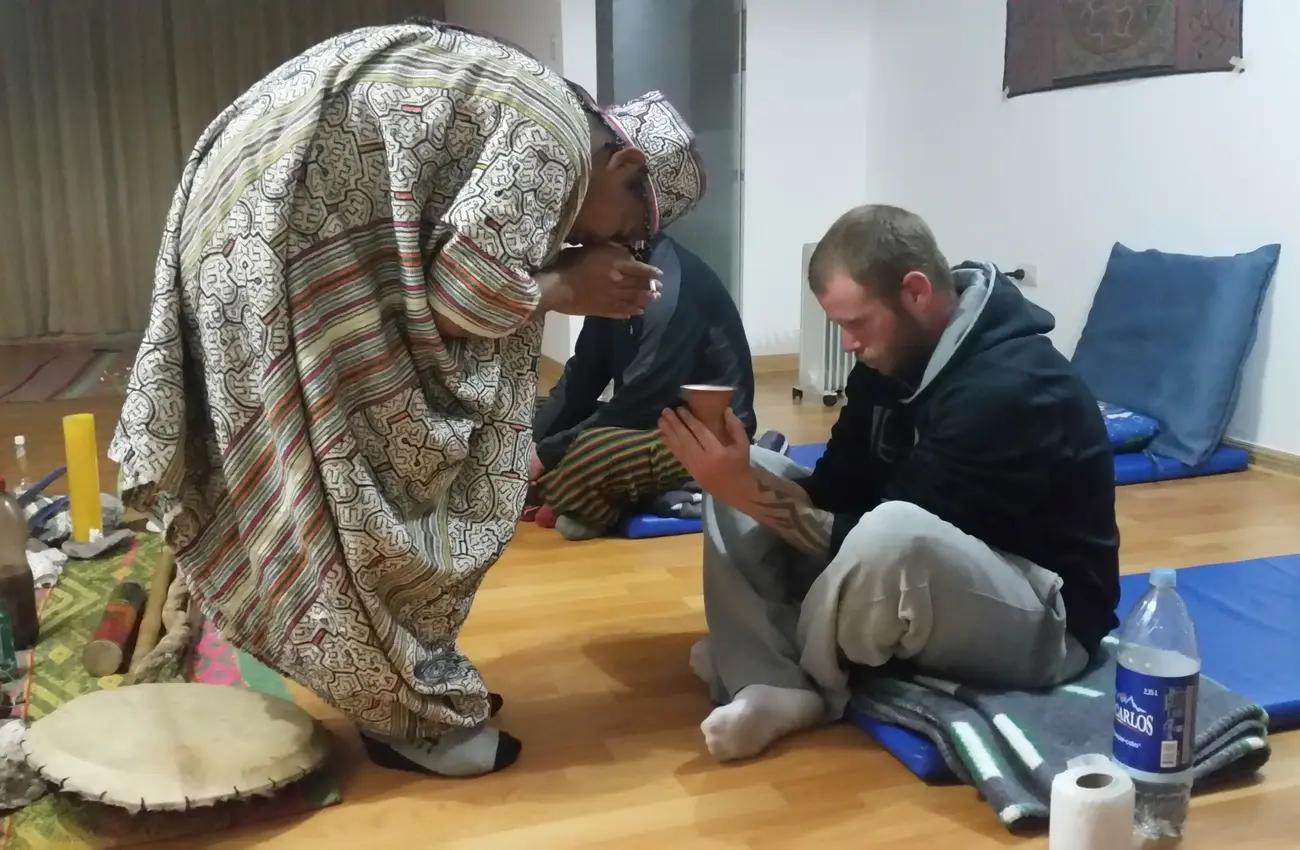
2 Day Ayahuasca Retreat Cusco
Our 2 Day Ayahuasca Retreat Cusco Peru offers a sacred space for those who seek profound healing and self-discovery in a short yet powerful journey.
The Urubamba River and Its Ceremonial Significance
The Urubamba — Willkamayu to the Incas — was considered the earthly reflection of the Milky Way. The celestial river that runs across the night sky of the Andean highlands has its counterpart in the Urubamba, and in Andean cosmology the relationship between the two was not metaphorical but literal: the world above and the world below mirrored each other, and the river was one of the points of intersection.
The sound of the Urubamba is a constant presence in the valley. In the quieter hours — the early morning after ceremony, the late afternoon before — its movement through the landscape creates an auditory anchor to the natural world that participants consistently notice and describe. This is not a small thing. Integration work — the process of grounding and embodying what arises during ceremony — is significantly shaped by the environment in which it occurs. A river that has been understood as sacred for over a thousand years, audible from the space where you are integrating your experience, provides a particular quality of ground.
Offerings to the Urubamba — coca leaves, flower petals, prayers — are part of the Andean ceremonial tradition that is woven into the fabric of retreats in this region. When a shaman makes an offering to the river before a ceremony, they are operating within a cosmological framework that understands the water as a living participant in the healing work.
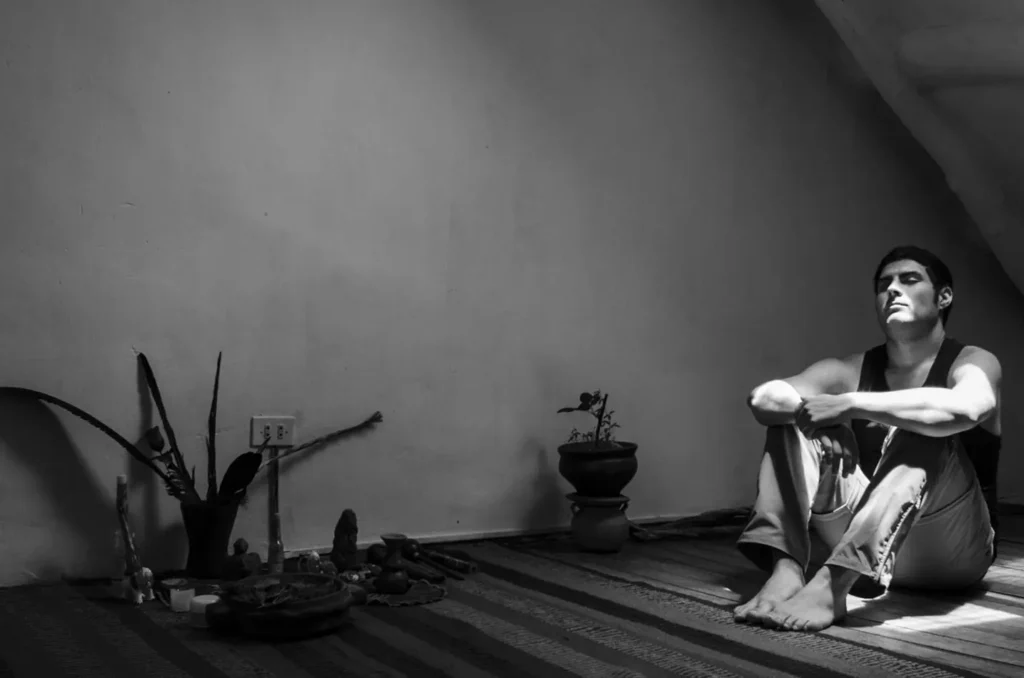
Healing center for Ayahuasca retreat in Cusco – Centro de sanación para retiro ayahuasca Cusco
The Apus: Sacred Mountains as Ceremonial Presence
In Andean cosmology, the mountains — Apus — are not passive geography. They are living spiritual entities, with personalities, with domains of influence, with the capacity to witness and support human ceremonial work. Each mountain has a name and a character understood across generations.
The Sacred Valley is flanked by peaks that include some of the most significant Apus in the Inca spiritual geography: Veronica (Waqaywillka) to the northwest, Pitusiray to the east, and the great peaks above Ollantaytambo visible on clear days from the valley floor. In the Andean healing tradition, a ceremony conducted in the presence of these mountains is conducted with them as co-participants — as witnesses whose attention is invoked and whose protection is sought.
This is not a marginal or decorative element of Andean ceremonial practice. The invocation of the Apus is a central part of how Andean healers open and hold a ceremonial space. When a ceremony in the Sacred Valley begins with the healer calling the mountains by name, that call is directed at specific presences that the tradition understands as genuinely responsive.
For participants arriving from cultural frameworks where mountains are geological features rather than spiritual entities, this dimension of the Sacred Valley setting often produces one of the most unexpected elements of the retreat experience: a quality of felt presence in the landscape that is difficult to explain and consistently reported.
Pachamama and Andean Cosmology in the Ceremonial Container
Alongside the Apus, Pachamama — Mother Earth — is a foundational presence in the Andean ceremonial framework. The relationship between Andean peoples and Pachamama is not symbolic in the way that “Mother Nature” functions in modern Western culture. It is understood as a living reciprocal relationship, one that requires active attention and offering.
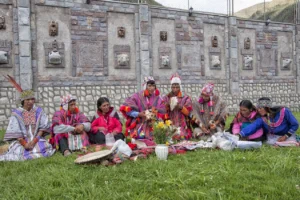
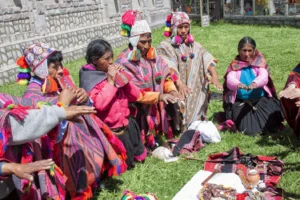
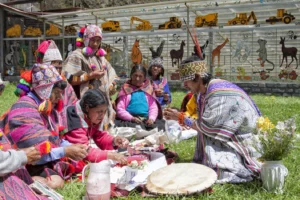
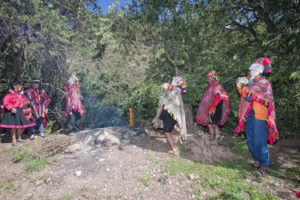
The despacho — the ceremonial offering to Pachamama — is a central ritual in Andean healing work. It involves the careful arrangement of sacred objects, coca leaves, flowers, seeds, and other elements into a bundle that is then burned as an act of reciprocity: giving to the earth what has been received from it. In the context of an ayahuasca retreat in the Sacred Valley, a despacho ceremony before or after ayahuasca work creates a ceremonial arc that connects the interior journey of the ceremony to the physical landscape that holds it.
Participants who have attended ceremonies in both the Amazon and the Sacred Valley consistently describe the Andean ceremonial container as having a distinctive quality — less oriented toward the depths of the psyche and more toward the relationship between the individual and the world. This is partly a function of the medicines (Wachuma, the Andean cactus, is typically more outward-facing than ayahuasca), but it is also a function of the cosmological framework: Andean healing orients toward relationship, reciprocity, and the restoration of right alignment between person and place.
The Inca Heritage Sites and Their Relationship to Ceremony
The Sacred Valley is bordered by some of the most significant Inca archaeological sites in Peru. Understanding them not as tourist attractions but as ceremonially significant locations gives the retreat context a dimension that purely logistical descriptions of the valley don’t capture.
Pisac. The ruins of Pisac, visible on the ridge above the town of the same name, include what archaeoastronomers have identified as one of the most sophisticated solar observatories in the Inca world. The intihuatana — the “hitching post of the sun” — functioned as an astronomical instrument for tracking solstices and equinoxes and calibrating the ceremonial calendar. A site used for millennia to track the relationship between the earth and the sun sits at the head of the valley where ceremonies are held.
Moray. The circular agricultural terraces of Moray, located on the plateau above the valley, are one of the more enigmatic Inca sites in the region. The concentric terraces create distinct microclimates at different levels, which Inca engineers used to test crops at varying altitudes. Their form — spiraling inward and downward — is visually and energetically distinctive in ways that participants who visit Moray during integration days frequently describe as significant.
Ollantaytambo. The massive stone fortress and temple complex at the northwestern end of the valley represents some of the most extraordinary Inca stonework in existence. The Temple of the Sun at Ollantaytambo was aligned with the summer solstice, and the pink granite blocks quarried from a mountain across the valley — transported by unknown means — speak to a commitment to this site as a place of genuine spiritual importance.
The Inca Trail and Machu Picchu. The trail that connects the Sacred Valley to Machu Picchu was not a hiking route in the modern sense. It was a pilgrimage path — a ceremonial journey undertaken with specific intention. Machu Picchu itself, at the end of the trail, was likely a royal retreat and astronomical-ceremonial center rather than a city in the ordinary sense. Its position on a ridge between two mountains, above a bend in the Urubamba, reflects the same cosmological principles — earth, water, mountain, sky in precise relationship — that structure Andean healing practice.
For participants who combine a Sacred Valley retreat with visits to these sites, the relationship between the ceremonial work and the cultural landscape often becomes one of the most meaningful aspects of the entire trip.
The Dual Lineage: Where Amazon Meets Andes
The most significant ceremonial characteristic that makes the Sacred Valley genuinely distinct from any other ayahuasca retreat destination in the world is this: it is the only place where both the Amazonian and the Andean healing traditions are authentically present simultaneously.
Ayahuasca is an Amazonian medicine. The Banisteriopsis caapi vine and the Psychotria viridis chacruna leaf both grow in the Amazon basin, not in the Andes. The Shipibo healing tradition — with its icaros, its dieta protocols, its understanding of the medicine as a plant teacher — comes from the lowland jungle. A ceremony in the Sacred Valley that draws from the Amazonian tradition is not a diluted version of a jungle ceremony. Amazonian curanderos have been practicing in Cusco for generations, bringing their medicine into the mountains and developing relationships with the Andean landscape in ways that have deepened over decades.
What the Sacred Valley adds is the Andean layer: the Apus invoked by name, the offerings to Pachamama, the despacho ceremonies, the specific cosmological framework of the Quechua tradition, and the presence of the sacred landscape itself as an active participant in the healing work. This dual lineage cannot be found in a jungle retreat near Iquitos, where the Andean tradition is genuinely absent. It also cannot be fully found in a ceremony that claims to be Andean without the authentic Amazonian plant medicine roots.
In the Sacred Valley, both are real and both are present. The icaros sung during an ayahuasca ceremony may draw from Shipibo healing songs and from Andean ceremonial tradition within the same night’s work. The shaman who leads the ceremony may hold training in both lineages. The landscape itself participates through its Apus and its Pachamama in ways that a jungle ceremony cannot.
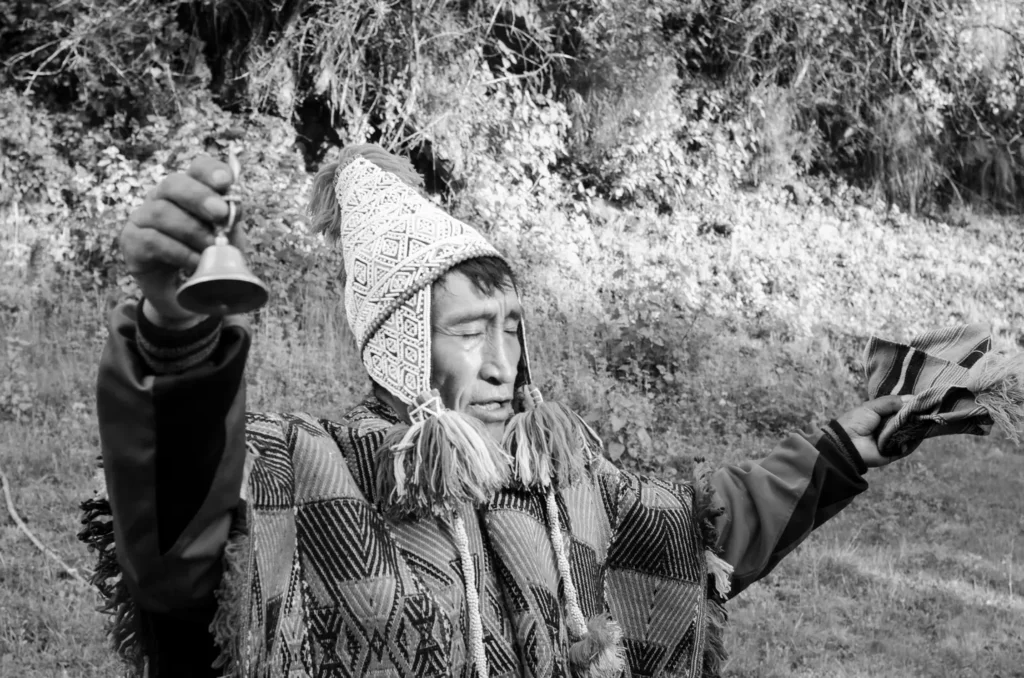
Shipibo shaman guiding ayahuasca retreat in Peru – Chamán shipibo ceremonia ayahuasca Perú
Sacred Valley vs. Cusco City: What Changes
Many participants ask whether a retreat in the Sacred Valley is meaningfully different from one in Cusco city. The answer is yes, in specific ways.
Physical setting. Cusco is a city of half a million people — urban, busy, at 3,400 meters of altitude. A retreat center operating within Cusco city is embedded in an urban environment with urban noise, energy, and logistics. The Sacred Valley — even in its most accessible towns like Pisac and Urubamba — is a qualitatively different physical environment: smaller communities, agricultural landscape, the river, the mountains more immediately present, the night sky genuinely dark.
Altitude. The Sacred Valley sits 400–600 meters lower than Cusco city. For participants arriving from sea level, the valley’s 2,800 meters is meaningfully easier on the cardiovascular and respiratory systems during the first days of acclimatization. This difference is not dramatic — both require proper acclimatization — but it is real and affects the physical state in which participants enter ceremony.
Immersion quality. A retreat in the Sacred Valley, particularly in a facility set in the agricultural landscape rather than within a town, creates a level of immersion in the natural environment that is difficult to achieve in an urban Cusco center. The space between you and the mountains is smaller. The sounds at night are quieter. The mornings after ceremony, walked in this landscape, carry a different quality than mornings in a city.
The sacred site proximity. In the Sacred Valley, you are within reach of Pisac, Moray, Ollantaytambo, and the trail to Machu Picchu. The integration days of a retreat here can include visits to these sites in ways that create a coherent ceremonial-cultural arc rather than separate tourist activities.
Sacred Valley vs. the Amazon: A Different Energy Entirely
The question of whether to do an ayahuasca retreat Sacred Valley Peru or an Amazon retreat near Iquitos is one of genuine difference, not just preference.
The Amazon jungle setting is primordial — hot, humid, intensely alive, surrounding you with the sounds of a living ecosystem at night. The darkness in a maloca in the jungle is a different darkness than the darkness in the Andes. The energy of the Amazon basin, where the vine grows wild and the tradition is oldest in its Shipibo form, provides a specific quality of immersion that the highlands cannot replicate.
What the Sacred Valley provides in its place is equally specific: the vast open quality of mountain landscape, the clean high-altitude air, the Andean cosmological context, the dual lineage, and the integration between the inner work of ceremony and the outer landscape of Inca heritage. Participants consistently describe Sacred Valley ceremonies as having an expansive, sky-oriented quality — where Amazon ceremonies tend toward depth and interiority, Sacred Valley ceremonies tend toward breadth and connection with the world.
Neither is superior. They are genuinely different experiences suited to different intentions and different people.
What the Altitude Means for Ceremony Here
At 2,800 meters, the Sacred Valley demands acclimatization from participants arriving from lower elevations. This is a practical reality, not a deterrent — and well-run retreat centers in the valley build it into their participant guidance as a matter of course.
Arrive at least two to three full days before your first ceremony. Use those days to rest genuinely — not to hike to Pisac or take day trips to Machu Picchu, but to rest, hydrate, drink coca leaf tea, eat lightly, and allow the body’s respiratory and cardiovascular systems to adapt. Altitude sickness (soroche) peaks 12–24 hours after arrival for most visitors and resolves within 48–72 hours with proper rest.
The combination of ayahuasca’s physiological demands — elevated heart rate, sustained altered state, possible purging — with an unacclimatized body is genuinely uncomfortable and potentially unsafe. Responsible centers in the Sacred Valley assess acclimatization status before proceeding with ceremony and will postpone when necessary.
The reward of this acclimatization is a body that, by the time of the ceremony, is operating in genuine equilibrium with the altitude — and which can then engage fully with the work of the medicine rather than fighting its own adaptive process simultaneously.
Combining a Sacred Valley Retreat with Cultural Travel
One of the most distinctive practical advantages of choosing an ayahuasca retreat Sacred Valley Peru is its position within the broader travel geography of southern Peru. The Sacred Valley is the corridor between Cusco and Machu Picchu — meaning that for travelers whose itinerary already includes the most visited archaeological site in South America, adding a retreat creates a coherent journey rather than a detour.
A realistic and balanced travel arc for 10–14 days:
Arrive Cusco. Rest two to three days for acclimatization, exploring the city gently. Take a day trip to the Sacred Valley — Pisac market, the ruins, the landscape — which simultaneously begins orienting you to the environment where your retreat will happen. Visit Machu Picchu (day trip or overnight in Aguas Calientes). Return to the Sacred Valley for your retreat. Allow integration days before departing — days that can include slower visits to Moray, Salineras, or Ollantaytambo from a place of post-ceremony openness.
The important sequencing principle: do the high-intensity physical activities (Inca Trail, altitude trekking) before the retreat, not after. The two to three days of recovery the ceremony requires afterward are integration days — gentle, reflective, grounded. They are not well-served by strenuous physical activity.
The Integration Landscape: Why the Days After Matter Here
Integration after ceremony is where the lasting work happens. And the Sacred Valley provides a specific kind of integration environment that deserves acknowledgment.
The days following ceremony in this landscape tend naturally toward the gentler activities that support integration: walking in the agricultural terrain, sitting by the Urubamba, visiting a site like Moray with a quality of openness the ceremony leaves behind, buying vegetables in the Pisac market on a Sunday morning when the Quechua vendors arrive in traditional dress from surrounding communities. These experiences, in the days immediately following a ceremony, have a grounding quality that urban environments make more difficult to access.
The landscape itself — the mountains, the river, the scale of the sky at altitude — reflects back something that participants in this state of heightened perception find available in a way it isn’t in ordinary life. The ceremony opens something; the Sacred Valley provides a container for that opening to settle and integrate.
Frequently Asked Questions
What is the difference between an ayahuasca retreat in the Sacred Valley and one in Cusco city?
The Sacred Valley sits at a lower altitude than Cusco (2,800m vs. 3,400m), offers a rural rather than urban setting, provides more direct contact with the natural landscape, and creates easier integration days through access to Inca sites and the Urubamba River. Most retreat centers in the Sacred Valley are embedded in agricultural landscape rather than city blocks, which produces a different quality of immersion. For participants whose retreat includes multiple days before and after the ceremony, the Sacred Valley setting generally supports that full arc more naturally than an urban environment.
Do I need to visit Machu Picchu to benefit from doing a retreat in the Sacred Valley?
No — the Sacred Valley has its own significant ceremonial landscape independent of Machu Picchu. Pisac, Moray, Ollantaytambo, and the valley itself are meaningful sites in their own right. That said, many participants do combine the retreat with a Machu Picchu visit, and the coherence between those experiences — the Inca heritage and the ceremonial work — is something they consistently describe as meaningful. The important thing is sequencing: major trekking and altitude excursions before the retreat, gentle cultural visits during integration days after.
Can I combine ayahuasca and San Pedro (Wachuma) ceremonies in the Sacred Valley?
Yes — and the Sacred Valley is the ideal location to do so, precisely because both medicines are authentically present in their respective traditions. San Pedro (Wachuma) is the Andean cactus medicine, native to the highlands and with deep roots in the ceremonial tradition of this specific geography. Ayahuasca brings the Amazonian lineage. Working with both in the Sacred Valley is working with both in their proper cultural and geographical context. Most experienced practitioners recommend spacing them appropriately — typically three to five days between ceremonies — and often suggest Wachuma before ayahuasca for first-time participants.
How does the altitude in the Sacred Valley affect the ayahuasca experience?
The altitude itself doesn’t fundamentally alter the pharmacological effects of ayahuasca, but it does affect the body’s cardiovascular response. At 2,800 meters, the heart and lungs are already working somewhat harder than at sea level. Ayahuasca produces its own cardiovascular activation — elevated heart rate and blood pressure — which compounds with the altitude effect. For properly acclimatized, healthy participants, this compound effect is well within normal range. For unacclimatized participants or those with cardiovascular conditions, it requires assessment. The two-to-three-day acclimatization before ceremony is not optional; it is a genuine safety measure specific to high-altitude retreat settings.
What Inca sites are accessible during integration days in the Sacred Valley?
Within easy reach: Pisac ruins and market (30 minutes from most retreat centers), Moray circular terraces and Salineras salt flats (45–60 minutes), Ollantaytambo fortress and temple (60–90 minutes), Chinchero (45 minutes), and the departure point for Machu Picchu (Ollantaytambo, with trains to Aguas Calientes). These are not tourist boxes to check — they are sites that participants in a post-ceremony state of heightened openness often describe as deeply resonant in ways that reinforce the ceremonial work rather than interrupting it.
An ayahuasca retreat Sacred Valley Peru — in the heart of Inca territory, in the presence of the Apus, at the intersection of Amazonian and Andean healing traditions — is one of the most distinctive ceremonial experiences available anywhere in the world. Our programs range from a 1-day ceremony to a 7-day immersion in this setting, and we also offer San Pedro (Wachuma) ceremonies for those drawn to the Andean medicine specifically or to a combined program.
Contact us to discuss which program fits your intentions, your time in Peru, and your level of experience.
Related reading: Where to Do Ayahuasca Retreat in Peru · Ayahuasca vs San Pedro (Wachuma) · What to Expect at an Ayahuasca Ceremony · How to Prepare for an Ayahuasca Retreat