What to expect ayahuasca ceremony — a complete guide covering every phase of the night, the shaman’s role, the purge, visions, difficult moments, and the morning after.
The most useful thing anyone can tell you about what to expect at an ayahuasca ceremony is also the most frustrating: no two ceremonies are alike, and no description of someone else’s experience will accurately predict yours.
That said, there is a reliable structure to how ceremonies unfold — a sequence of phases, a set of roles, a progression from opening to peak to descent to morning — that holds across traditions, locations, and individual experiences. Understanding that structure doesn’t tell you what you’ll see or feel. What it does is give you a map of the terrain, so that when something unexpected happens in the middle of the night, you have some context for where you are and what it might mean.
This guide is written specifically for ceremonies in Cusco and the Sacred Valley — an Andean ceremonial context that differs in meaningful ways from an Amazon jungle retreat. The structure has parallels, but the setting, the energetic character, and the specific elements of the ceremony reflect both Amazonian and Andean traditions simultaneously.
Table of Contents
Before the Ceremony Begins: Arrival and Orientation
The ceremony officially begins before you drink anything.
In the afternoon or early evening of a ceremony day, most retreat centers hold an orientation session. At Ayahuasca Cusco, this typically takes place a few hours before the ceremony begins — a space for the facilitating team to review what the night involves, answer questions, and check in with each participant individually.
This session matters more than it might seem. It is when facilitators assess how you are physically and emotionally — whether the acclimatization to altitude has settled, whether anything unexpected has come up since your last conversation, whether you are carrying particular anxiety or intention that affects how the ceremony will be approached with you specifically. It is also your opportunity to share what feels alive for you going into the night: what you are hoping to work with, what you are afraid of, what has surfaced in the preparation period.
Use this time honestly. The facilitators are not assessing you for worthiness. They are gathering the information they need to support you well through the hours ahead. A fear you express here can be held with care during the ceremony. A fear you suppress here will likely be found by the medicine anyway — but without context for the people whose job it is to support you.
After the orientation, there is typically a quiet period before the ceremony begins. Use it to eat nothing (the stomach should be empty), to journal if you feel moved to, to rest, and to begin settling inward. The conversation and social energy of the day start to quiet. The transition has already begun.
Ayahuasca Retreats in Cusco
1 Day Ayahuasca Retreat Cusco
Designed for visitors with little time seeking a profound spiritual experience, the 1 Day Ayahuasca Retreat in Cusco, Peru is meant for them.
2 Day Ayahuasca Retreat Cusco
Our 2 Day Ayahuasca Retreat Cusco Peru offers a sacred space for those who seek profound healing and self-discovery in a short yet powerful journey.
The Ceremonial Space: What the Maloca Looks Like
The ceremony takes place in a maloca — a ceremonial space dedicated specifically to this work. In the Amazonian tradition, the maloca is a large round or oval structure open to the surrounding environment. In Cusco and the Sacred Valley, the ceremonial space may take different architectural forms while maintaining the same energetic function: a dedicated, protected space that holds the work of the night.
When you enter the maloca for the first time, you will find:
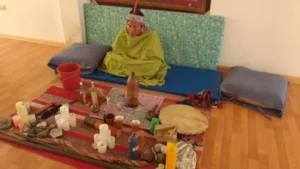
A personal space assigned to you — a mattress on the floor with blankets and a pillow. The mattresses are typically arranged in a circle or semicircle, with the shaman and facilitators positioned at the center or one end of the space. A bucket is placed near each mattress — for the purge if it comes. In well-run ceremonies, there is also a designated bathroom area accessible during the night.
The lighting is minimal or absent. Ceremonial work with ayahuasca takes place in darkness or near-darkness for a specific reason: the absence of external visual stimulation allows attention to turn inward, where the medicine works. The darkness is not incidental — it is part of the ceremonial container.
Take a few minutes to settle into your space before the ceremony begins. Arrange your blanket, place your journal nearby if you want it, and get comfortable. You will be here for the better part of the night.
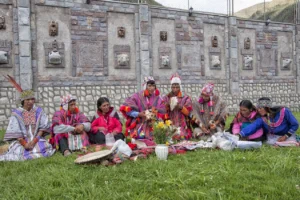
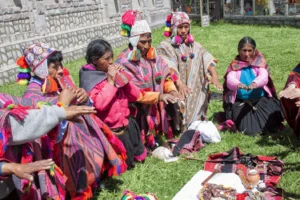
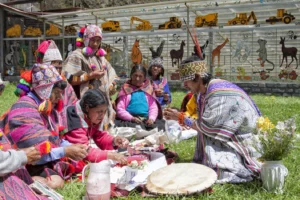
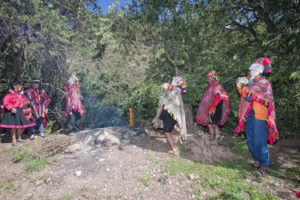
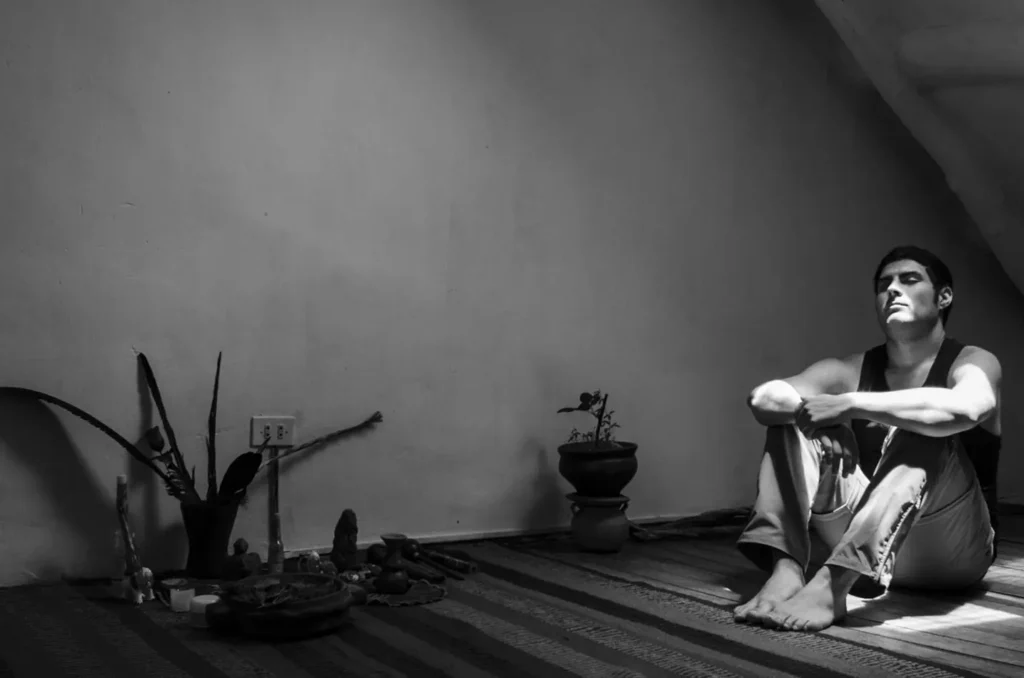
In ceremonies in Cusco, you may also notice Andean ceremonial elements that would not appear in a strictly Amazonian maloca: offerings to Pachamama, representations of the Apus (sacred mountain spirits), or the presence of sacred objects specific to the Andean healing tradition. These are not decorative — they are part of how this specific tradition works.
The Opening: Invocations, Cleansing, and the First Cup
The formal beginning of the ceremony varies by tradition and shaman, but certain elements are common.
Cleansing of the space. Before the brew is served, the shaman cleanses the ceremonial space — typically with mapacho (sacred Amazonian tobacco), palo santo, or other plant medicines. The smoke is used to clear and protect the energetic boundaries of the maloca. If you are close enough to receive the smoke directly, you may experience it as a blessing or energetic clearing. It is appropriate to receive this with openness.
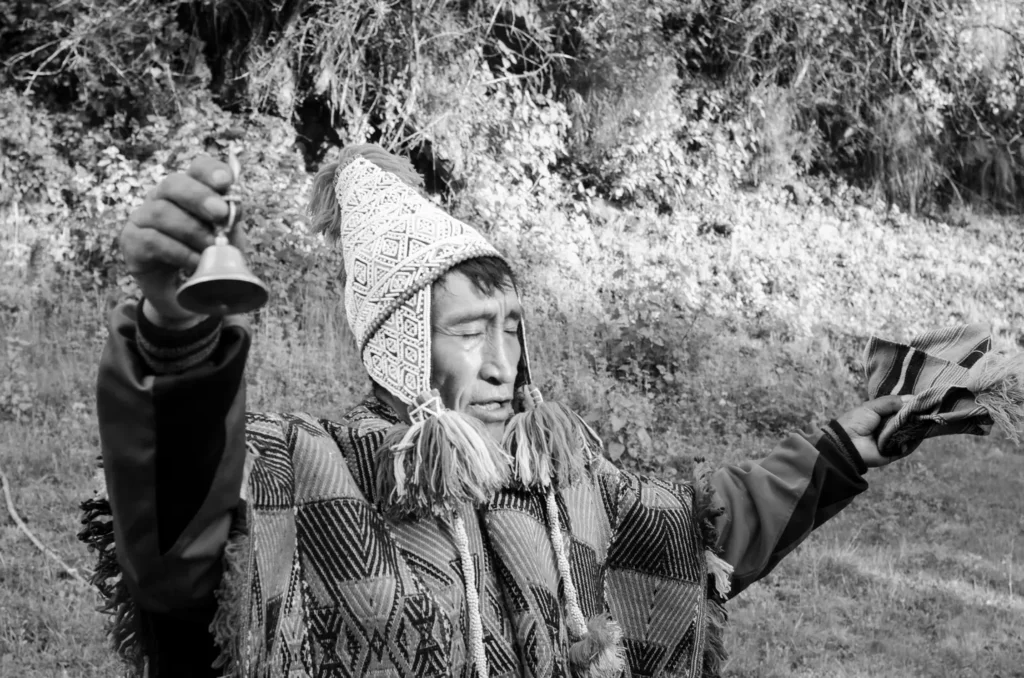
Opening invocations. The shaman calls in protective spirits, plant teachers, ancestors, or — in the Andean dimension — the Apus and Pachamama. These invocations are not theatrical. They are the healer’s way of opening the ceremonial space, establishing its boundaries, and setting the direction of the night’s work. Even if you do not share the cosmological framework within which they operate, receiving them with respect is appropriate.
Blessing the brew. The shaman blesses the ayahuasca before serving it — singing or chanting over the vessel, working with the medicine’s spirit before it is shared. In the Shipibo tradition, this often involves the first icaros of the night, sung directly to the brew.
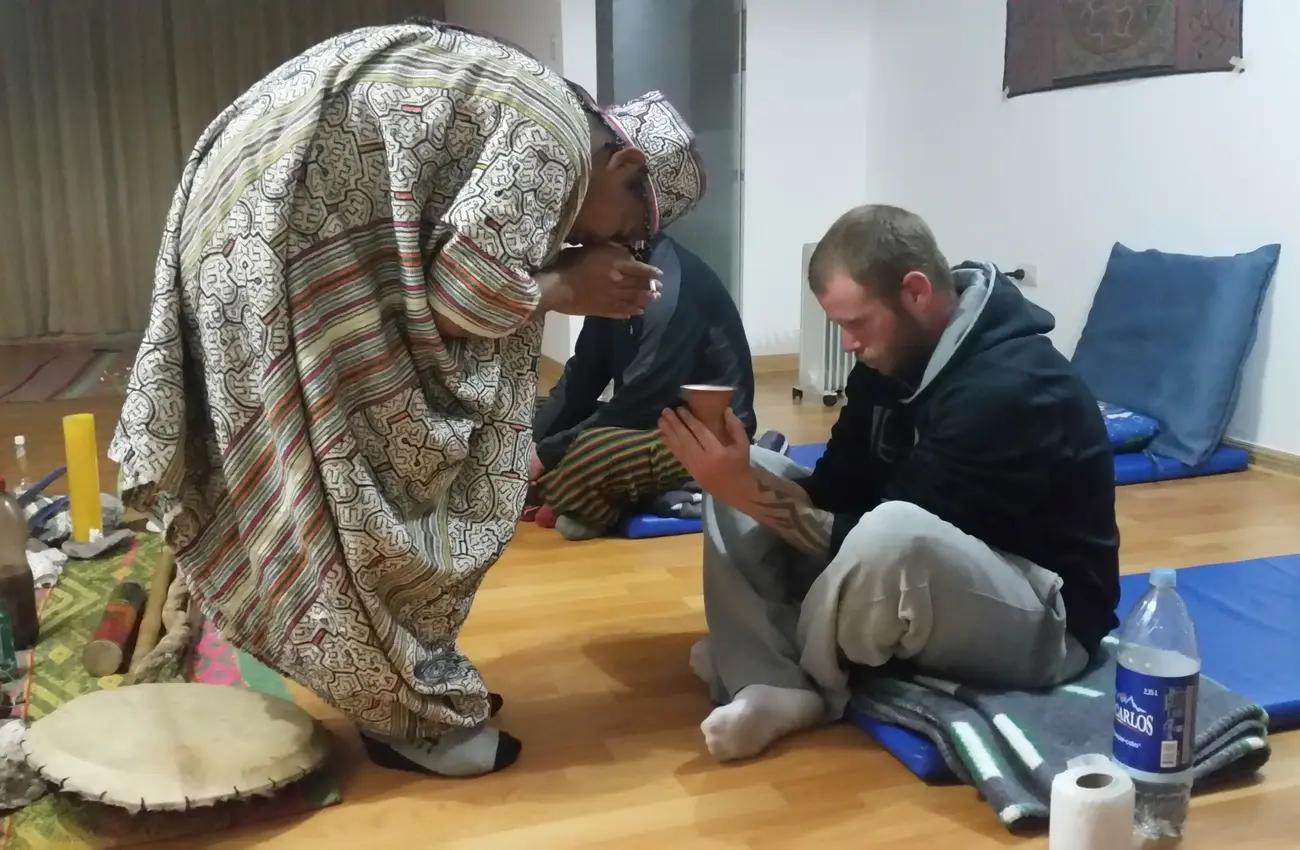
Serving the medicine. Participants approach the shaman one by one to receive their cup. The amount served varies by individual — for first-time participants, a lower starting dose is common, allowing both the healer and the participant to assess how the medicine lands before deciding whether a second cup is appropriate. The brew is typically dark, thick, and intensely bitter. Drink it deliberately. After swallowing, return to your space.
The moment after drinking, settle onto your mattress. Put on your eye mask if you have one. Pull your blanket close. Lying down is encouraged — the medicine is easier to navigate horizontally. Close your eyes. And wait.
Shipibo shaman guiding ayahuasca retreat in Peru – Chamán shipibo ceremonia ayahuasca Perú
Phase 1 — The Onset (Minutes 0–45): Waiting and the First Signs
This is the phase most participants find the most psychologically challenging — not because anything intense is happening, but because nothing is happening yet, and the mind fills the silence with noise.
Onset typically begins between 20 and 45 minutes after drinking. For some participants it starts sooner — 15 minutes — and for others it takes longer, particularly in first ceremonies when the body is unfamiliar with the medicine. The variation is normal. Do not interpret a slow onset as “it’s not working.” Do not drink a second cup impulsively because you don’t feel anything after 20 minutes. Wait.
The first signs are often subtle: a slight shift in how your body feels, a tingling in the extremities, a change in the quality of darkness behind your eyes, a faint awareness that your perception is beginning to alter. Some people describe it as warmth spreading through the body. Others notice a visual quality to the darkness — geometric patterns forming at the edges of awareness, or a sense that the blackness behind closed eyes has become alive with texture and movement.
Alongside these physical signals, the mind often becomes unusually active in this phase. Thoughts accelerate. Old concerns resurface. The internal narrator becomes louder, sometimes filling the space with commentary, judgment, or anxiety. This is not a malfunction. This is the mind’s last moment of full control before the medicine begins its work. Experienced practitioners often describe this as the ego’s final rally — the habitual self-referential system asserting itself before it begins to quiet.
The appropriate response to this phase is patience and a gentle return of attention to the breath whenever the mind’s chatter becomes overwhelming. You do not need to suppress the thoughts. You simply do not need to follow every one of them.
Phase 2 — The Purge (Hours 1–2): Physical and Emotional Release
For many participants, the transition from onset to full effect is marked by the purge. This is the aspect of ayahuasca ceremonies that most people are nervous about in advance, and it deserves honest treatment.
What the purge is: Vomiting occurs in roughly 70% of ayahuasca ceremony participants. It is not considered, in the tradition that works with this medicine, to be a sign that something has gone wrong. It is considered la purga — the cleansing — a physical release of what the medicine is drawing to the surface. Diarrhea, sweating, yawning, crying, and trembling are also forms of purging. All of them are understood as forms of release.
The experience of purging during an ayahuasca ceremony is different from ordinary nausea. It is often described as a release rather than an illness — something coming out rather than something invading. The body feels lighter almost immediately afterward. Some participants report profound emotional release simultaneous with physical vomiting — a grief that wasn’t accessible before suddenly present and moving through at the same moment the body expels.
What to do when the purge comes: Use your bucket. Do not resist it. Resistance tends to make the experience more uncomfortable without preventing anything. Once it passes, return to your position. Drink a small amount of water if it is available. The facilitator may approach to offer support — allow this without embarrassment.
If you don’t purge: Roughly 30% of participants experience no physical vomiting. This does not mean the ceremony is not working. The purge is one form of release, not the only one. Some of the deepest ceremonial experiences involve no physical purging and a great deal of emotional or cognitive processing instead.
The emotional purge: Sometimes what releases is not physical at all. Crying — sometimes sustained, sometimes sudden, sometimes inexplicable — is one of the most consistent features of ayahuasca ceremonies. Grief that has been managed for years finds a way out. Fear that has been intellectually controlled becomes palpable. The body shakes with something that was being held. These are forms of release, and they pass in their own time.
Phase 3 — The Peak (Hours 2–4): The Depth of the Journey
After the purge, when the body has released what it needed to release, the medicine often deepens rather than subsides. For many participants, the most significant part of the ceremony begins here.
The visionary experience. The quality and intensity of visual phenomena varies enormously between individuals and between ceremonies. Some participants experience vivid, complex geometric patterns that fill the visual field — intricate, moving, luminous. Others encounter symbolic imagery: animals, landscapes, figures, scenes from memory or imagination. Some have experiences that feel like encounters with presences — beings or energies they may interpret through a spiritual, psychological, or entirely personal framework.
Others have what feels like a primarily emotional or cognitive ceremony, with minimal visual content but profound emotional processing, altered perception of time, or a quality of insight and clarity that doesn’t take a visual form. This is equally valid and equally meaningful. The medicine does not work the same way for everyone, and the absence of dramatic visions does not indicate a less valuable experience.
What the experience feels like from the inside. The most consistent descriptions across thousands of participant accounts involve a shift in the quality of self-referential awareness. The ordinary narrating voice — the continuous inner commentary about who you are, what you think, what is happening — becomes quieter or disappears entirely. In its place, something else becomes available: a quality of direct perception, of being present with experience rather than narrating it. This is one of the reasons ayahuasca is described as showing rather than telling.
Difficult material often surfaces in this phase: buried memories, suppressed fears, grief that hasn’t been processed, patterns of behavior seen with sudden and sometimes uncomfortable clarity. This is not punishment. It is the medicine’s way of addressing what has been carried below awareness. The traditional understanding is that you are being shown what needs to be addressed so that you can address it — with the medicine’s support and with the shaman’s guidance.
Time perception. Time behaves differently during the peak. What feels like hours may be twenty minutes, and vice versa. This disorientation is normal and not cause for concern. The shaman’s icaros and the facilitation team’s presence serve as anchors — reminders that there is a container around the experience, that it has a beginning and will have an end.
The second cup. In many ceremonies, a second serving of the medicine is offered after the first has established itself — typically 45 minutes to an hour after the first. The decision about whether to take a second cup is made collaboratively between the participant and the facilitating team. There is no obligation either way. For some people, one cup is more than sufficient. For others, a second deepens the work. Experienced facilitators will make a recommendation based on what they observe.
Phase 4 — The Descent (Hours 4–6): Coming Back
At some point in the night — typically between four and six hours after drinking — the peak begins to soften. The visual intensity, if present, gradually reduces. The emotional charge settles. The ordinary sense of self begins to reassert itself, slowly and sometimes tentatively.
This phase is often described as a landing — the process of returning to ordinary awareness from somewhere significantly different. For many participants it brings a quality of profound peacefulness: a sense of having passed through something, of the body and mind settling into rest, of the maloca and the other people in it becoming present again in a way they weren’t during the peak.
The descent is often when insights crystallize. The emotional material that was active at the peak begins to become more comprehensible — not necessarily fully understood, but present in a way that is available for reflection rather than overwhelming. Many participants have their most clear and articulable insights during this phase, once the intensity has softened enough to allow them to be held consciously.
Journal if you can during this phase. Not a formal analysis — just images, feelings, phrases, anything that was present during the night. The clarity of ceremony memories can fade surprisingly quickly, and what feels indelible at 3am may be significantly less accessible by noon the following day.
The Close of Ceremony: The Shaman’s Final Work
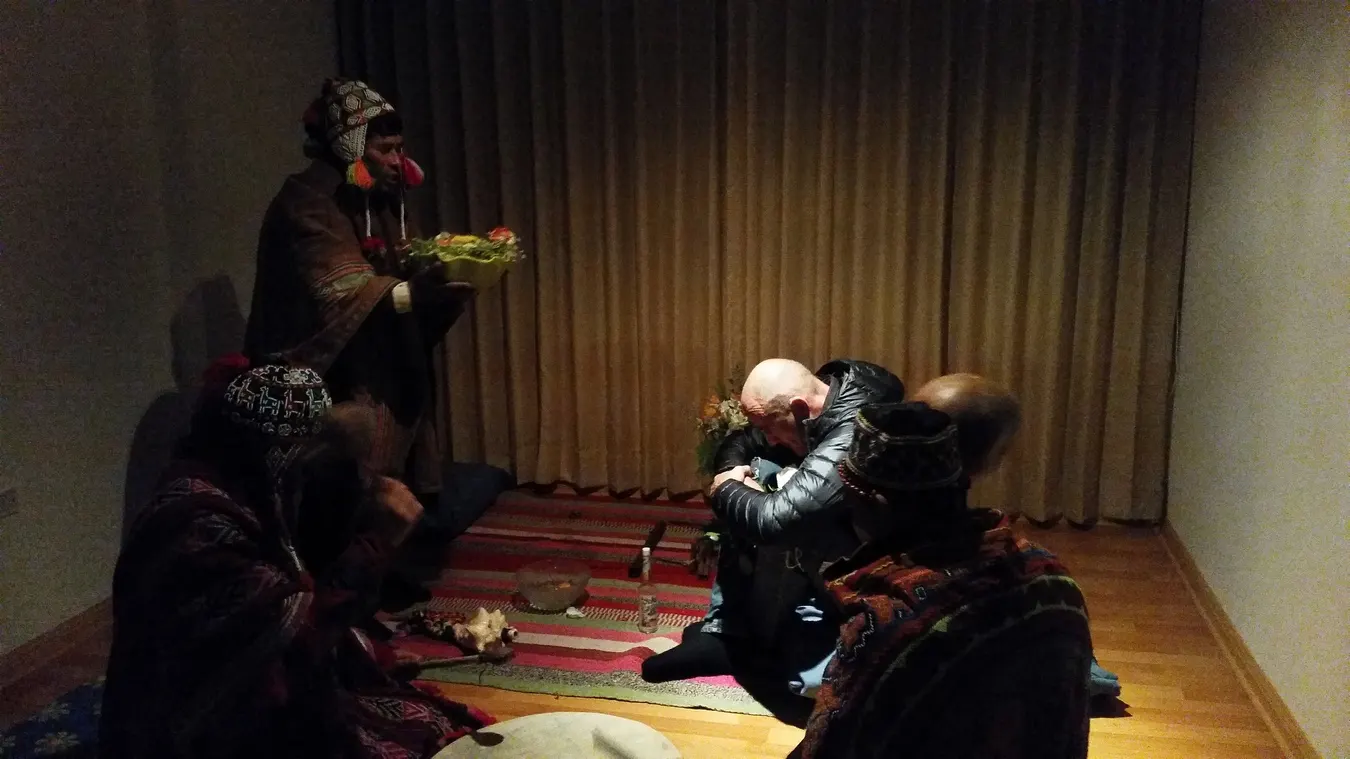
The formal close of the ceremony is led by the shaman. This typically involves final icaros — songs of completion, of grounding, of returning — along with cleansing work with tobacco or other plant medicines to close the energetic space that was opened at the beginning of the night.
The shaman may move through the group for individual attention — a final cleansing, a specific icaro for a particular participant, a moment of direct energetic work. This is not cause for concern if it happens to you. It is not an indication that something is wrong. The shaman is completing the work of the night.
When the ceremony is formally closed, the facilitating team will indicate that it is safe to speak quietly, move around, or leave the maloca briefly. Most participants remain in the space for some time after closing — there is no hurry. The transition back to ordinary social interaction happens naturally and at its own pace.
The closing of the ceremony is not the end of the experience. The medicine continues to work through the night and into the following day. Dreams in the hours after ceremony are often vivid and meaningful. The state of heightened sensitivity that many participants report in the days after a ceremony begins here, in the quiet hours before dawn.
The Morning After: What to Expect When Dawn Comes
The morning following an ayahuasca ceremony is its own distinct phase of the experience — one that most descriptions of ceremony overlook entirely.
How you may feel physically: Most participants wake after a ceremony feeling tired but not depleted — there is a quality of physical tiredness that feels clean, like the body has done significant work. Some people feel physically light in a way that’s unusual. Some have a mild headache, particularly if they didn’t hydrate adequately during and after the ceremony. The digestive system may remain sensitive.
Eat lightly when you feel ready — fresh fruit, plain oatmeal, a clear broth. Nothing heavy, nothing fried, nothing on the restricted list. Your body is still in a state of heightened sensitivity and doesn’t need the additional processing load of a large meal.
How you may feel emotionally: The range is wide. Some participants wake with a profound sense of clarity and peace — a quiet certainty that something has shifted, an emotional lightness they hadn’t felt in years. Others feel raw and fragile, like a membrane that normally provides some protection has temporarily thinned. Both are normal. Both pass in their own time.
If difficult material surfaced during the night, it may be present in the morning too — not necessarily with the same intensity as in ceremony, but accessible in a way it wasn’t before. This is part of what integration addresses. The morning is not the time to process everything analytically. It is the time to rest, be gentle, and allow what is present to be present.
What to do the morning after: Rest. Write in your journal. Eat something simple. Spend time outdoors if possible — the morning light and open air after a night of deep interior work is grounding in a way that is difficult to explain but consistently described. Avoid intense social interaction for the first few hours. Avoid screens. Allow the morning to be slow.
At Ayahuasca Cusco, integration circles take place the morning following each ceremony — a structured space for participants to share what arose during the night, ask questions of the facilitating team, and begin making sense of the experience together. These are optional but valuable. Putting language to what happened, hearing others’ experiences, and receiving guidance on what you encountered are important parts of the early integration process.
Healing center for Ayahuasca retreat in Cusco – Centro de sanación para retiro ayahuasca Cusco
What the Shaman Does Throughout the Night
Understanding the shaman’s role hour by hour helps participants understand why certain things happen when they happen — and reduces the anxiety of the unfamiliar.
The icaros. The healing songs are the shaman’s primary tool. They are not ambient music. Each icaro has a specific function — some open the space at the beginning of the night, some call in protective spirits, some are sung to specific participants during moments of difficulty or deep process, some are songs of celebration and completion that mark the approach of the close. The shaman reads the energy of the group continuously and selects icaros accordingly.
When the shaman moves from playing background music to singing specific icaros to a particular participant, it typically indicates that the healer is doing active work with that person — clearing something, supporting a process, or bringing their attention and healing intention to bear. There is no need to do anything different when this happens. Receive it with openness.
Mapacho and plant medicine tools. Sacred Amazonian tobacco (mapacho) is used throughout the ceremony as a cleansing and directing agent — blown into the ceremonial space, sometimes blown gently toward participants as an energetic tool. Floral waters, other plants, or Andean ceremonial objects may also be used depending on the tradition. If you have strong sensitivities to smoke, mention this before the ceremony.
Individual work. In ceremonies with multiple participants, the shaman and facilitating team move through the group throughout the night, spending time with individuals as needed. This is not random — the healer perceives which participants need attention and when. Some participants receive a great deal of individual attention; others receive less. Both are appropriate to the night’s work.
Holding the space. Perhaps the most important and least visible part of what the shaman does is the continuous maintenance of the ceremonial container — the energetic boundaries of the space that allow the experience to unfold safely. This is constant and ongoing throughout the night, in ways that are not always visible to participants.
When the Ceremony Is Difficult: What to Do and What Not to Do
Difficult experiences during ayahuasca ceremonies are normal, expected, and not a sign that something has gone wrong. They are often — not always, but often — where the most significant work happens.
What a difficult ceremony looks like: Intense fear, grief, or despair. Visions that are disturbing or confronting. The sensation of losing control, or of being unable to return to ordinary awareness. Physical discomfort beyond the usual purge. A sense of encountering something overwhelming or incomprehensible.
What to do:
Stay with your breath. When experience becomes overwhelming, returning attention to the physical sensation of breathing is the most reliable anchor available. Not to suppress what is arising — but to provide a thread back to the present moment from within an intense experience.
Call on a facilitator. This is what they are there for. There is no threshold of difficulty you need to reach before it is appropriate to signal for support. A facilitator can sit with you, offer grounding through physical presence, provide reassurance about what is happening and that it will pass.
Avoid physical escape attempts. The impulse to get up and leave the maloca when an experience becomes difficult is common and understandable. In most cases, moving into the physical space of the ceremony rather than leaving it — even if that means crawling to the bucket or to a facilitator — is preferable to attempting to leave. The ceremonial space is held precisely to contain these moments.
Remember: it will pass. The peak of any difficult moment in an ayahuasca ceremony has an endpoint. The medicine does not stay at maximum intensity indefinitely. The phase you are in will shift.
What not to do:
Do not take supplements or medications without consulting your facilitation team during the ceremony. If a medical need arises, facilitators are trained to handle it — let them make the assessment.
Do not sing loudly, speak, or make disruptive sounds if it can be avoided. The ceremonial space serves everyone in the room simultaneously, and significant noise from one participant impacts others.
Do not leave the ceremonial space without notifying a facilitator. If you need the bathroom or fresh air, gesture for a facilitator’s attention first.
The Difference Between Your First and Subsequent Ceremonies
In retreat programs with multiple ceremonies, the arc across consecutive nights is often as significant as what happens within a single night.
The first ceremony tends to be one of orientation — the body and mind encountering the medicine for the first time, the system adjusting to the quality of the altered state, the shaman and the participant beginning to develop a relationship. Many people find the first ceremony more physically intense than subsequent ones (the purge may be more pronounced) and more disorienting, because there is no prior reference point.
It is also common for the first ceremony to feel incomplete in some way — like an introduction rather than a resolution. This is appropriate. The medicine is meeting you. It is assessing what you are carrying and beginning to work with it. The depth of subsequent ceremonies is often enabled by the first one, even when the first feels unremarkable or overwhelming in ways that don’t yet make sense.
Subsequent ceremonies in a multi-day retreat often go deeper. The body is less resistant, the mind less distracted by the novelty of the experience, and the shaman has more information about what the participant is working with. Many participants find the second or third ceremony the most significant of a retreat — the ground cleared by the first night allowing for work that wasn’t accessible before.
This is one of the reasons experienced practitioners recommend retreats of at least three days with multiple ceremonies, rather than single-night experiences. Not because more ceremonies is always more — but because the sequence allows for a depth that a single night rarely reaches.
Experiences That May Concern You (But Are Normal)
Several common ceremonial experiences are not widely described in preparation guides, which means participants encounter them unprepared. The following are normal:
Not feeling anything. Approximately 15% of first-time participants describe experiences where the medicine produces minimal or no noticeable effects. If this happens, it does not mean you are resistant, defective, or that the ceremony failed. Some participants’ bodies require more than one encounter with the medicine before connecting deeply. Some have profound experiences on subsequent nights after an apparently quiet first ceremony.
Feeling like the experience is not “spiritual enough.” Many participants arrive with expectations shaped by other people’s dramatic accounts — visions, encounters with entities, profound revelations. Their own experience may be quieter, more emotional, less visually spectacular — and they conclude, incorrectly, that they “didn’t get it.” Ayahuasca works with what each person needs, not with what they expect.
Hearing other participants. In a group ceremony, you will hear other people — purging, crying, making sounds of difficulty or release. This is normal and expected. It can be disorienting if you are unprepared for it. Each person’s experience is their own and is separate from yours, even though you share a physical space. Focus on your own process.
Feeling completely sober and aware. Some participants spend portions of the ceremony in what feels like an entirely ordinary state of consciousness — present, clear, aware of their surroundings, without the altered quality they expected. This state can alternate with deeper phases throughout the night. Trust the fluctuation.
The experience continuing the next day. Heightened emotional sensitivity, vivid dreams, a sense that the medicine is “still working” — these are common in the 24 to 72 hours after a ceremony. They are part of the process, not a cause for concern.
What a Ceremony in Cusco Specifically Looks Like
A ceremony in Cusco and the Sacred Valley has distinctive characteristics that reflect the dual Amazonian and Andean heritage of this region.
The setting is the Andes rather than the Amazon. The energy of the mountains — particularly the Apus, the living mountain spirits of Andean cosmology — is present in ceremonies here in ways that participants consistently describe as palpable. The altitude, the cold night air, the particular quality of silence in the highlands — all of these are part of the ceremonial container in ways unique to this geography.
The shamans working in Cusco typically carry both Amazonian and Andean elements in their practice. Icaros from the Amazonian healing tradition are woven together with Andean ceremonial songs, coca leaf offerings to Pachamama, and invocations to the Apus who witness and support the work. This integration of two healing lineages is specific to Cusco and not something that can be replicated in either a jungle retreat or an Andean ceremony that doesn’t include plant medicine.
Practically, ceremonies in the Sacred Valley begin typically around 8–9pm and close between 2–4am, though this varies by center and by the specific needs of a particular night. The altitude means the nights are cold — bring warm layers, and use them. The Andean silence between the shaman’s songs has its own quality: a depth of quiet that participants in jungle settings — surrounded by wildlife and insects — don’t experience in the same way.
At Ayahuasca Cusco, each ceremony is preceded by the health and intention check-in described earlier, followed by orientation, the ceremony itself, and a morning integration circle. Each program — from a single ceremony to a 7-day immersion — includes preparation guidance, facilitated ceremony nights, and integration support, because the ceremony itself is only one part of the complete experience.
Frequently Asked Questions
How long does an ayahuasca ceremony last?
Most ceremonies last between 4 and 6 hours from the time the medicine is consumed. Some run longer — 7 or 8 hours — depending on the tradition, the shaman, and the specific needs of the group. In Cusco, ceremonies typically begin between 8–9pm and close between 2–4am. The day following the ceremony is considered part of the ceremonial process and requires rest, gentle integration, and continued restriction of diet and stimulants.
Will I definitely vomit?
Roughly 70% of participants experience some vomiting during ceremony. Roughly 30% do not. The purge, when it happens, is considered part of the medicine’s cleansing function — not a side effect to be managed. If you do not purge, this is not an indication the medicine is not working. Both experiences are equally valid.
What if I feel nothing?
If the medicine produces minimal or no effects on a first ceremony, inform your facilitating team. In a multi-ceremony retreat, subsequent nights may produce very different experiences. A quiet or apparently uneventful ceremony is not a failure. Some of the most significant shifts in participants’ lives follow ceremonies they initially described as “nothing happening.”
Can I go to the bathroom during the ceremony?
Yes, but signal to a facilitator before leaving the ceremonial space. In altered states, navigating an unfamiliar environment at night requires support. Facilitators are present specifically to assist with practical needs like this without interrupting the ceremonial container.
What should I do if the experience becomes overwhelming?
Focus on your breath. Signal for a facilitator — that is their role and they are trained for exactly these moments. Avoid trying to physically leave the ceremonial space without guidance. Remember that what you are experiencing has a timeline — the peak will pass, the intensity will shift, the night will end. The ceremonial container exists precisely to hold these moments.
Is it normal to feel emotional for days after the ceremony?
Yes. Heightened emotional sensitivity in the 24–72 hours following an ayahuasca ceremony is among the most consistently reported post-ceremony experiences. The medicine continues its work beyond the night itself, and the emotional material surfaced during the ceremony continues to be processed in the days that follow. This is part of why integration support in the days after the ceremony — not just during it — matters significantly.
Does everyone have visions?
No. Approximately 70–80% of participants describe some form of visual experience — geometric patterns, symbolic imagery, or more narrative scenes. Others have experiences that are primarily emotional, physical, or cognitive without significant visual content. Neither profile indicates a more or less valuable ceremony. The medicine works with what each individual needs, which varies by person, by night, and by what is being carried into the space.
Have more questions about what to expect at an ayahuasca ceremony in Cusco? Contact us directly — we answer every question honestly and without pressure. Our retreat programs range from a single-day ceremony to a 7-day immersion in the Sacred Valley, each with full preparation guidance, facilitated ceremonies, and integration support.
Related reading: What is Ayahuasca? · The Ayahuasca Diet · How to Prepare for an Ayahuasca Retreat · Benefits of Ayahuasca