San Pedro Ceremony: What to Expect — a complete hour-by-hour guide covering the opening rituals, mescaline onset, peak experience, the shaman’s role, and the closing in Cusco’s Sacred Valley.
A San Pedro ceremony lasts a full day. That fact — simple as it sounds — shapes everything about how you prepare for it, what you bring, how you orient yourself during the experience, and what you do when it ends. Eight to twelve hours is a long time to be in an altered state outdoors in the Andes, and understanding what that time actually looks like — phase by phase, from opening to close — changes what is available to you when you arrive.
This guide gives you the honest, practical picture of what to expect at a San Pedro Wachuma ceremony in Cusco and the Sacred Valley: what happens, when it happens, what the healer is doing while it happens, what the experience itself tends to feel like at each stage, and what you should know before you arrive.
Table of Contents
Why San Pedro Ceremonies Happen During the Day
The most fundamental difference between a San Pedro ceremony and an ayahuasca ceremony is the time of day — and this is not a cultural preference or a logistical convenience. It reflects something genuine about how the medicine works.
Ayahuasca’s characteristic depth and interiority — the intense visionary states, the dissolution of ordinary ego, the journey into the unconscious — is served by darkness and horizontal stillness. The night, the closed eyes, the maloca create a container that turns attention inward and holds it there.
San Pedro’s characteristic quality is the opposite: outward-facing, expansive, oriented toward the natural world and the body’s presence within it. Mescaline heightens sensory perception — colors become richer, sounds fuller, the physical world more vivid and present. The medicine wants daylight, open air, and the living landscape as active participants in the ceremony.
In the Andean tradition, San Pedro ceremonies begin at sunrise or shortly after for this reason. The early morning light on the mountains, the quality of the air before the day warms, and the gradual opening of the natural world as the sun rises all participate in how the medicine works. By the time the experience peaks — typically in the late morning and early afternoon — the participant is in full contact with the Andean landscape at its most luminous.
This is not backdrop. The mountains, the river, the sky — these are understood in the Andean tradition as co-participants in the ceremony. The Apus (sacred mountain spirits) are invoked by name at the opening. Pachamama (Mother Earth) is addressed directly. The ceremony happens with the landscape, not merely in it.
Before the Ceremony: Arrival and the Opening Rituals
Participants arrive in the morning — typically between 7 and 9am depending on the center. The early time is deliberate: it allows the full arc of the experience to unfold during daylight, with the close of the ceremony in late afternoon or early evening.
The period between arrival and drinking the medicine is not idle time. The opening rituals — which may last 45 minutes to 90 minutes — are a genuine part of the ceremony. They orient participants to the ceremonial space, clear the energetic field, and create the intentional container that holds the day’s work.
What typically happens in this opening period at our ceremonies in the Sacred Valley:
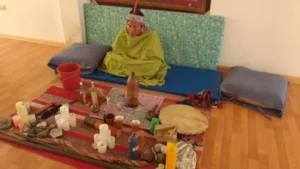
Settling in. Participants are shown the ceremonial space — the area where they will spend the day. In the Sacred Valley, this is typically an outdoor space with some shade available, surrounded by the Andean landscape. Participants can place a blanket, lay out personal items, and get physically comfortable.
Group orientation. The facilitating team reviews what the day will look like: the timing of the medicine, what the different phases of the experience tend to feel like, what participants can and should do during the ceremony, and what the facilitators’ roles are. This is also the time to share any last-minute health concerns or questions with the team.
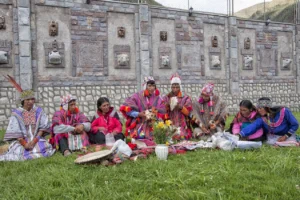
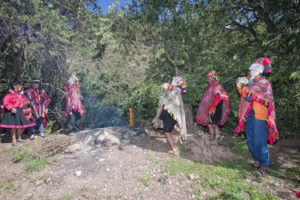
The opening prayer. The healer opens the ceremonial space formally — typically through prayers addressed to Pachamama, to the Apus of the specific mountains surrounding the Sacred Valley, and to the spirit of the San Pedro cactus. These are not symbolic gestures. They are direct communications to presences that the Andean tradition understands as genuinely alive and genuinely responsive.
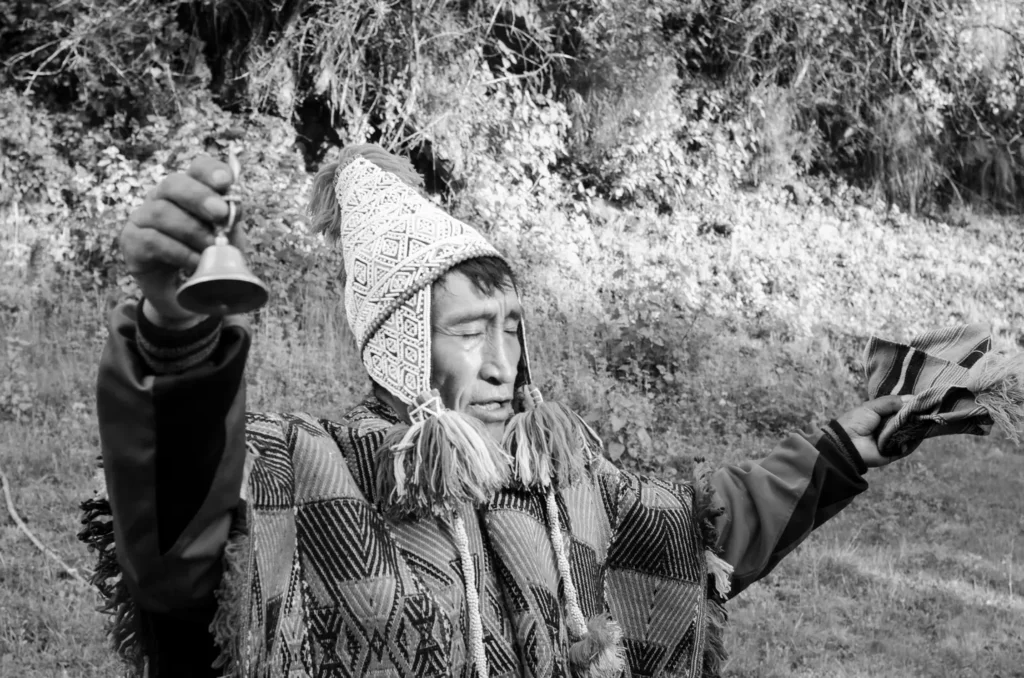
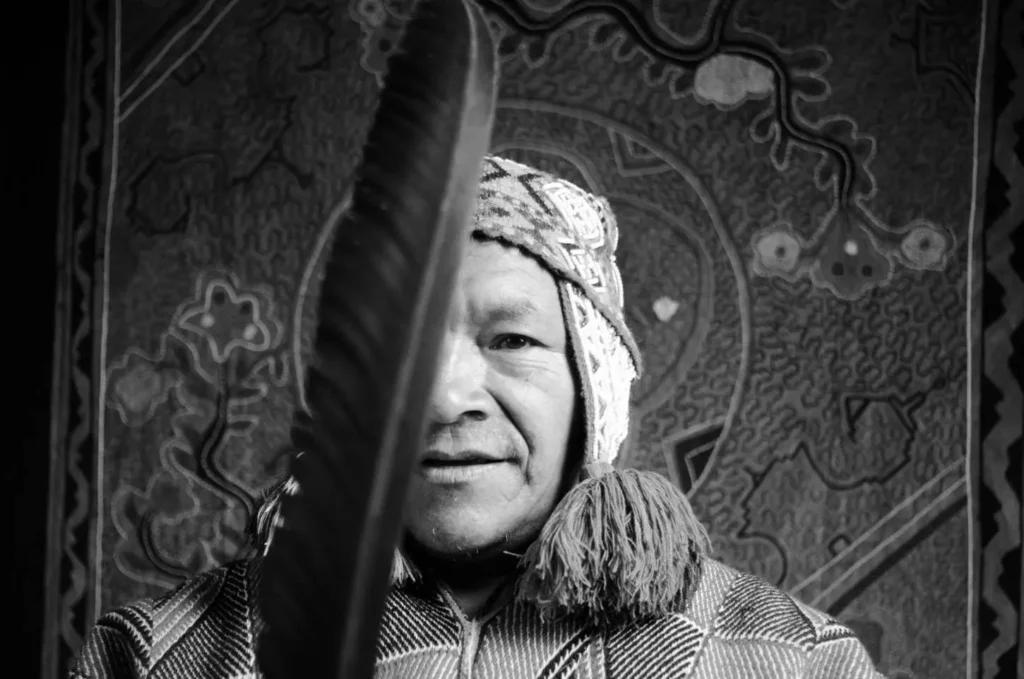
Shipibo shaman guiding ayahuasca retreat in Peru – Chamán shipibo ceremonia ayahuasca Perú
The Coca Leaf Reading
One of the distinctive elements of ceremonies in Cusco and the Sacred Valley is the coca leaf reading (despacho de coca) that often precedes the medicine.
Coca leaves — Erythroxylum coca, the same plant from which cocaine is derived but used here in a completely different form and context — have been central to Andean spiritual practice for thousands of years. In traditional Andean healing, coca leaves are used as a diagnostic and communicative tool: the healer reads the leaves to identify what a participant is carrying, what areas of their energy need attention, and what the medicine’s work will likely focus on during the day.
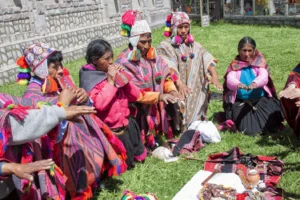
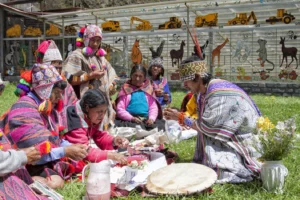
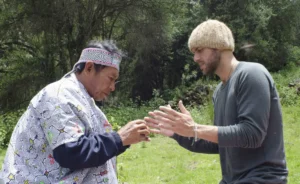
The reading is conducted by the healer or a specialized reader. Participants are typically asked to blow their intention into a handful of coca leaves before the reading begins — a physical act of offering what they are bringing into the ceremony. The leaves are then read by the healer, who shares observations about the participant’s energetic and emotional state.
This is a personal and often surprisingly accurate experience. Many participants describe the coca leaf reading as the moment the ceremony genuinely begins — the moment something in them recognized that what was about to happen was real, not theoretical.
Not all centers include a coca leaf reading as standard; it is a traditional Andean element more common in Cusco-based ceremonies than in purely Amazonian contexts.
Complete information and booking: Coca Leaf Reading Cusco →
The Energetic Cleansing
Following the coca leaf reading, most traditional ceremonies in Cusco include an energetic cleansing (limpia) before the medicine is served.
This cleansing is performed by the healer using a combination of tools depending on the tradition: mapacho (sacred Amazonian tobacco) blown across the body, floral water (agua florida) sprinkled or wiped over the head, shoulders, and hands, and sometimes palo santo or other aromatic plants passed through the aura of each participant.
The limpia is understood as a clearing of accumulated energetic debris — the dense emotions, stress, and old patterns that block receptivity. Practically, it also has a calming and centering effect: the sensory experience of the tobacco smoke and the floral water, combined with the healer’s attention to each person individually, brings participants into the present moment and out of the mental activity of the morning.
After the limpia, participants are ready to receive the medicine.
Complete information and booking: Negative Energy Cleansing Ceremony Cusco →
Drinking the Medicine: The First Cup
The San Pedro brew is prepared from the outer green flesh of the Echinopsis pachanoi cactus, cooked for many hours into a concentrated liquid. The color ranges from bright green to dark olive depending on preparation time and quantity used. The taste is characteristically bitter, somewhat earthy, and for many participants — unpleasant. Drinking it deliberately, without rushing, is the appropriate approach.
Participants typically approach the healer one by one to receive their cup. The amount served varies by participant based on the healer’s assessment and the participant’s experience level.
For first-time participants, a moderate dose allows the healer to gauge how the medicine lands before deciding whether a second serving later in the ceremony is appropriate. This decision is made during the ceremony, not in advance.
After drinking, participants return to their space and settle in. The medicine begins working in 30 to 90 minutes for most people — more gradually than ayahuasca, and with a less dramatic transition into the altered state.
Phase 1 — The Onset (Minutes 30–90): Waiting and First Signs
The onset period is the one that most participants find psychologically challenging — not because of anything intense happening, but because of the waiting. The mind, accustomed to immediate feedback, begins filling the space with commentary: Is it working? Am I feeling something? Was the dose enough?
The first signs of San Pedro’s effects are subtle and easy to miss if you’re looking for something dramatic. A slight change in how the light looks. A quality of aliveness in the landscape that wasn’t quite there before. A tingling warmth, sometimes, in the hands or chest. A gentle increase in heart rate. The colors of the mountains or the sky becoming, slowly, more saturated.
Some participants notice nausea in this phase — mild and typically passing within 30 to 60 minutes. This is the most common physical discomfort associated with San Pedro, and it affects roughly 20-30% of participants. If nausea arises, slow breathing, gentle movement, and the availability of a bucket nearby are sufficient for most people. Purging is uncommon but not unheard of; when it occurs, it tends to be brief.
The appropriate response to the onset phase is patience. Sit with your back supported, with the landscape in front of you. Breathe slowly. The medicine is working even when the first signs are not dramatic.
Phase 2 — The Opening (Hours 2–4): The Experience Deepens
As the medicine establishes itself — typically between 90 minutes and 3 hours after drinking — the quality of the experience shifts from subtle to unmistakable.
The most consistent description across participant accounts is a deepening of sensory perception. The world becomes more vivid: colors more saturated, sounds more textured, the physical environment more alive. In the Sacred Valley, this manifests as a quality of presence in the mountains that participants consistently describe as extraordinary — the Apus surrounding the valley become, in some difficult-to-articulate way, more there than they were before.
The emotional field opens in this phase. Something loosens in the chest — a quality of warmth and receptivity that many participants describe as the beginning of the heart-opening that characterizes the medicine. Old feelings may surface, not with the confrontational intensity of ayahuasca, but with a gentleness that makes them approachable. A grief that has been managed for years may simply be felt — not forced, not excavated, just present and moving.
Movement becomes natural and even important during this phase. San Pedro does not ask you to lie still. Walking slowly through the landscape, sitting on the earth, touching plants and stones — these physical interactions with the natural environment are part of how the medicine works, not distractions from it. Many participants spend portions of this phase walking in the landscape surrounding the ceremony site, attending to what the medicine is opening.
The healer’s presence during this phase is active. They move among participants, offering attention where needed, singing or praying quietly, attending to the energetic quality of the ceremonial space.
Phase 3 — The Peak (Hours 4–7): Full Presence
The peak of a San Pedro ceremony is not a moment of overwhelming intensity that requires enduring. It is, for most participants, a period of what can only be described as exceptional presence — an experience of being fully, unusually alive in the world.
Colors may be intensely vivid. The Andean light at altitude has a quality that participants in their ordinary state find beautiful; in the peak of a San Pedro ceremony, that beauty can become almost overwhelming in its precision and richness. The sky over the Sacred Valley. The texture of the stone terraces. The sound of the Urubamba River carrying from below. These ordinary elements of the landscape become, during the peak, extraordinary.
Cognitively, the experience has a specific quality that distinguishes it from other altered states: clarity rather than confusion. Many participants describe the peak as a period of unusual lucidity — the ability to see their own patterns, relationships, and life choices from a wider and less defensive perspective. Things that had seemed complicated become, briefly, obvious. Decisions that had seemed impossible present themselves with surprising simplicity.
Emotionally, the peak tends toward openness and warmth. The Grandfather energy of San Pedro — patient, generous, wise — is most present here. Participants may cry without sadness, feel deep gratitude without a specific object, or experience a quality of love for other people and for life itself that feels both surprising and completely natural.
Visual phenomena may appear: geometric patterns with eyes closed, intensified colors and textures with eyes open, occasional more symbolic imagery. San Pedro’s visual dimension is generally less dramatic than ayahuasca — more an intensification of perception than a replacement of it. Most participants remain fully oriented in time and space throughout the ceremony.
The healer continues their work during the peak, attending to each participant as needed. Individual healing work — the healer sitting with a specific participant, singing to them, working with their energy directly — often happens during this phase.
Phase 4 — The Descent (Hours 7–10): Coming Back
At some point in the late afternoon — typically 7 to 10 hours after drinking — the experience begins to settle. The peak’s intensity gradually softens. The extraordinary quality of perception begins to return toward the ordinary, though it rarely returns immediately or completely by the close of ceremony.
The descent is often described as a landing — a gradual return to ordinary awareness that feels more like a gentle lowering than an abrupt ending. Many participants find this phase the most integrative: the insights and emotional movements of the peak begin to consolidate into something speakable, something that can be thought about and carried forward.
This is when to write in your journal if you have it. Not a formal analysis — but impressions, images, phrases, anything that was present during the peak that you want to hold onto. Ceremony memories can be more fluid than they feel in the moment; what seems indelible at 3pm may be significantly less accessible by the following morning.
As the descent unfolds, participants often naturally begin gathering together, moving back toward the ceremonial space, and orienting toward the close of the ceremony.
The Close of Ceremony
The formal close is led by the healer, typically in the late afternoon. This involves a final set of prayers and offerings — to Pachamama, to the Apus, and to the spirit of the San Pedro cactus — closing the ceremonial space that was opened in the morning.
Many ceremonies include a despacho offering at the close: a bundle of sacred objects, coca leaves, flowers, and food offerings assembled during the ceremony and burned or buried as an act of gratitude and reciprocity to the natural world and the mountain spirits.
After the close, participants gather for a shared meal — simple, warm, prepared in alignment with the dietary protocol. This first food after a long day in altered states is a grounding experience. The conversation around the meal tends to be quiet and personal, a natural integration circle where participants share fragments of what the day brought them.
The Evening After
The San Pedro experience does not end abruptly at the formal close of ceremony. Most participants feel the medicine continuing to work in the hours after — a quality of heightened emotional sensitivity, vivid awareness, and openness that extends into the evening.
Plan for a quiet night after a San Pedro ceremony. This is not the time for restaurants, social engagements, alcohol, or heavy entertainment. A gentle evening — perhaps a short walk, early dinner, time to journal, early sleep — honors the process that is still unfolding.
Dreams after a San Pedro ceremony tend to be vivid and meaningful. Keep a journal by the bed.
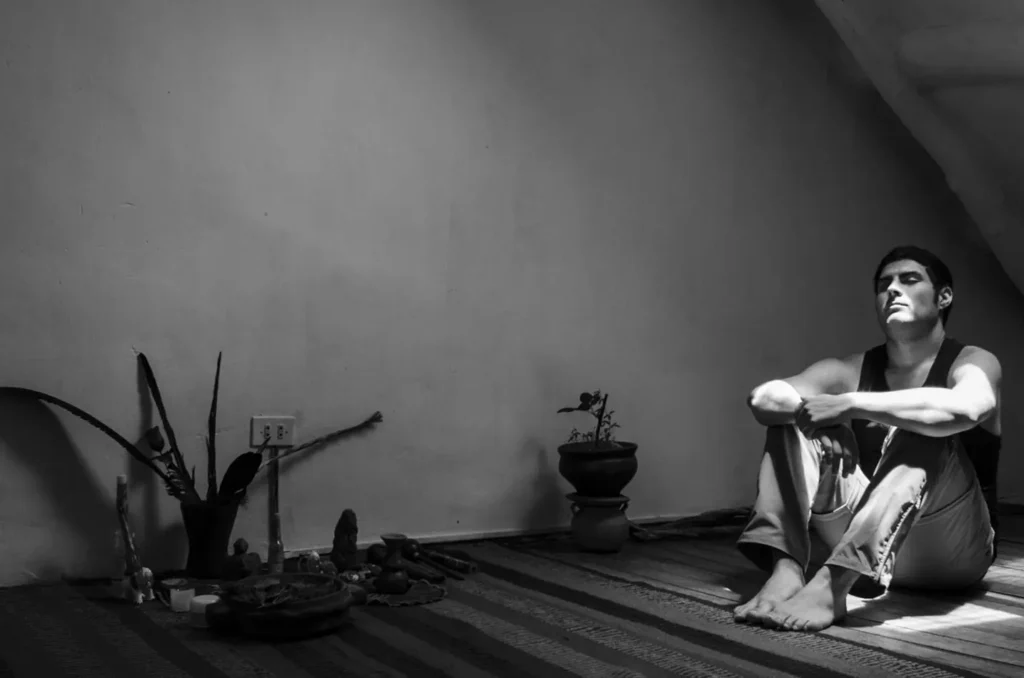
Healing center for Ayahuasca retreat in Cusco – Centro de sanación para retiro ayahuasca Cusco
What the Healer Does Throughout the Day
Understanding the healer’s role in a San Pedro ceremony helps participants understand what is happening when the healer approaches them, what the songs and prayers are for, and why the ceremonial container requires someone trained to hold it.
Unlike an ayahuasca ceremony — where the icaros (healing songs) are the primary ceremonial tool, sung continuously throughout the night — San Pedro ceremonies in the Andean tradition involve a different relationship between the healer and the participants. The healer holds the space, watches the energy of each participant, and moves through the group attending to individuals as needed. Their tools include:
Prayers and invocations. Continuous communication with Pachamama, the Apus, and the spirit of the cactus throughout the ceremony. These are not decorative — they are the healer’s ongoing maintenance of the ceremonial container.
Songs (icaros). Present in San Pedro ceremonies but less continuously central than in ayahuasca ceremonies. The healer may sing to the group, to specific participants during individual healing work, or as part of the opening and closing rituals.
Mapacho (tobacco). Sacred tobacco is blown across participants for protection and cleansing at various points during the day. The smoke is understood as a carrier of prayer and as a protective agent.
Physical presence and attention. The healer watches each participant throughout the day — observing energy, reading what the medicine is doing with each person, and deciding when to approach for individual work. When they sit with you specifically, they are working with your energy directly.
Individual healing work. The healer may sing directly to specific participants, use rattles or other ceremonial instruments, or work physically (hands near but not on the body) to support particular processes that are unfolding.
Movement, Silence, and Practical Logistics
Movement: San Pedro ceremonies expect and welcome movement. You are not required to sit in one place for 10 hours. Walking slowly within the ceremonial area, sitting on the earth, lying on your blanket, moving to a different spot — all of this is appropriate. What is not appropriate is leaving the ceremonial area without informing a facilitator.
Silence: Many traditions recommend limiting verbal conversation during the ceremony, particularly during the peak hours. This is not a rule about politeness — it is a recognition that conversation pulls attention out of the interior process the medicine is facilitating. Quiet and inner attention are the appropriate mode during ceremony. The time for sharing and conversation comes at the close.
Bathroom: Fully accessible throughout the ceremony. Inform a facilitator if you need to walk somewhere unfamiliar, as orientation can be subtly affected by the medicine. Most ceremony sites have facilities immediately nearby.
Phone: Leave it off or at your accommodation. A phone in ceremony — even face down — creates a background pull toward the ordinary world that undermines the process.
Second cup: Some facilitators offer a second serving of the medicine during the ceremony, typically 2-3 hours after the first. This is discussed with each participant individually and is never pressured. For some participants a second cup deepens the work; for others one cup is more than sufficient. The decision is yours.
What to Bring to a San Pedro Ceremony
Essential:
- Comfortable, loose clothing in layers — Andean weather can shift from warm to cold and back, often within hours. The morning can be cold; the midday sun at altitude is intense; the late afternoon can cool quickly
- A warm jacket or blanket for the morning and evening
- A wide-brimmed hat and sunscreen — the Andean sun at 2,800+ meters is powerful, especially during the peak hours when you may spend time outdoors
- Good walking shoes suitable for uneven terrain
- A journal and pen
- A personal item of meaning if you have one — a photograph, a stone, something connected to your intention
- Water bottle (the ceremony site will typically have water available, but having your own is helpful)
Leave behind:
- Your phone, or at minimum keep it completely off and put away
- Perfumes and heavily scented products
- Expectations written in stone
Difficult Moments During Ceremony: What to Do
San Pedro is generally considered gentler than ayahuasca, and genuinely overwhelming or frightening experiences are less common. That said, the medicine can and does bring up difficult emotional material, and some participants experience anxiety, disorientation, or physical discomfort during the day.
If you feel anxious: Focus on your breath. Ground yourself physically — feel the earth beneath you, the texture of your blanket, the weight of your body on the ground. Signal a facilitator. They are there for exactly these moments and will sit with you, offer grounding presence, and help you navigate what is arising.
If you feel nauseous: Allow it rather than fighting it. Have your bucket accessible. Slow, deliberate breathing helps. Most nausea in San Pedro ceremonies passes within the first two hours; sustained intense nausea beyond that point should be communicated to a facilitator.
If the experience feels overwhelming: Remember that what you are feeling has a timeline. The medicine’s effects peak and descend on their own schedule, and they always resolve. No difficult experience in a San Pedro ceremony lasts the entire day. The healer’s capacity to work with what is arising — through their presence, their songs, their attention — exists precisely for these moments.
If you want to leave: Communicate this to a facilitator rather than attempting to leave independently. In most cases, what feels like an urgent need to escape is itself something the medicine is presenting for attention rather than a genuine emergency. The facilitators will assess the situation and, if leaving is genuinely appropriate, will support that.
What a Ceremony in the Sacred Valley Specifically Looks Like
The Sacred Valley setting shapes the ceremony in ways that participants from other retreat contexts consistently notice and describe as distinctive.
The mountains are present in a way that is felt rather than merely seen. When the healer invokes the Apus by name at the opening — Veronica, Pitusiray, the great ranges visible to the south — those invocations are directed at specific presences that Andean tradition understands as alive and responsive. At the peak of the San Pedro experience, with mescaline heightening sensory perception and emotional openness, the sense of being witnessed and held by these mountains becomes unusually vivid.
The agricultural landscape of the valley — the ancient Inca terraces carved into the hillsides, the Urubamba flowing below, the quinoa fields and the livestock and the communities of Pisac and Urubamba going about their daily life — creates a ceremonial container that is embedded in a living world rather than removed from it. You are not in an isolated retreat bubble. You are in a valley that has supported human ceremonial and agricultural life for thousands of years.
Our San Pedro ceremony takes place in the Huayllapampa area, close enough to Cusco for logistical accessibility while far enough from the city to be surrounded by the open Andean landscape. The ceremony includes the coca leaf reading, the energetic cleansing, and the full ceremonial arc described in this guide.
Frequently Asked Questions
How long does a San Pedro ceremony last?
Most San Pedro Wachuma ceremonies last between 8 and 12 hours, beginning in the morning (typically 7-9am) and closing in the late afternoon or early evening. The medicine itself remains active for 8-12 hours. The ceremony’s formal structure — opening rituals, medicine, full experience, closing — occupies that entire window.
Will I be able to walk and talk during the ceremony?
Yes, for the most part. Unlike ayahuasca ceremonies, where participants remain lying down in a darkened space, San Pedro ceremonies involve movement and some verbal communication (though quiet is generally preferred during the peak hours). Most participants are able to walk within the ceremonial area, eat light food when offered toward the close, and engage in quiet conversation with facilitators throughout the day.
What if I don’t feel anything?
A small percentage of participants report minimal effects from San Pedro, particularly on a first ceremony. If the effects feel very subtle, inform your facilitators — they may offer a second serving if appropriate, or provide guidance on what to attend to. Sometimes the medicine’s work is less dramatic and more quietly present than participants expect; what felt like “nothing happening” can become apparent as meaningful shift in the days following.
Is it normal to cry during a San Pedro ceremony?
Yes. Emotional release of many kinds — crying, laughing, feeling deep love or gratitude, releasing grief — is common and considered a natural part of the medicine’s work. San Pedro opens the heart in a very literal experiential sense, and that opening frequently involves emotions that have been held back surfacing gently. In the ceremonial context, this is welcomed rather than embarrassing.
Can I eat during the ceremony?
Light food — fresh fruit, a small piece of bread — may be offered by facilitators at appropriate moments, typically in the later stages of the ceremony when the peak has passed. Eating during the peak hours is generally not recommended as it can increase nausea. The full meal at the close of the ceremony is the natural point for eating.
What happens the day after a San Pedro ceremony?
Most participants feel well the following day — tired, perhaps, and emotionally tender, but not depleted in the way that can follow an intense ayahuasca ceremony. The heightened sensitivity of the peak has resolved, but many participants describe a sustained quality of clarity and emotional openness that persists for days. Rest, gentle activity, and continued light eating are appropriate for at least one full day following the ceremony.
Ready to experience a San Pedro Wachuma ceremony in the Sacred Valley? Our 1-day San Pedro ceremony offers the complete ceremonial arc described in this guide — coca leaf reading, energetic cleansing, full-day ceremony, and closing ritual — guided by experienced Andean healers in the landscape where this tradition has been practiced for millennia.
Contact us to discuss whether San Pedro, ayahuasca, or a combined program is the right fit for your intentions and timeline.
Related reading: What Is San Pedro (Wachuma)? · Benefits of San Pedro Wachuma · San Pedro Diet Before Ceremony · Ayahuasca vs San Pedro · What to Expect at an Ayahuasca Ceremony